

The Aeolian Islands, besides being a magnet for tourism, geology, and nature, also offer a unique setting for understanding the profound dynamics of one of the Mediterranean's most complex and fascinating volcanic systems. In this archipelago, where degassing, hydrothermal activity, and magmatic intrusions coexist in confined spaces, even small ground movements can reveal significant changes in the processes governing the evolution of active volcanism.
The use of GNSS systems offers an unprecedented ability to measure ground movements with millimeter precision. In contexts dominated by rapid and complex processes, geodetic networks provide continuous, high-resolution data that allow the detection of subtle but significant deformations, often precursors to changes in the state of the volcano.
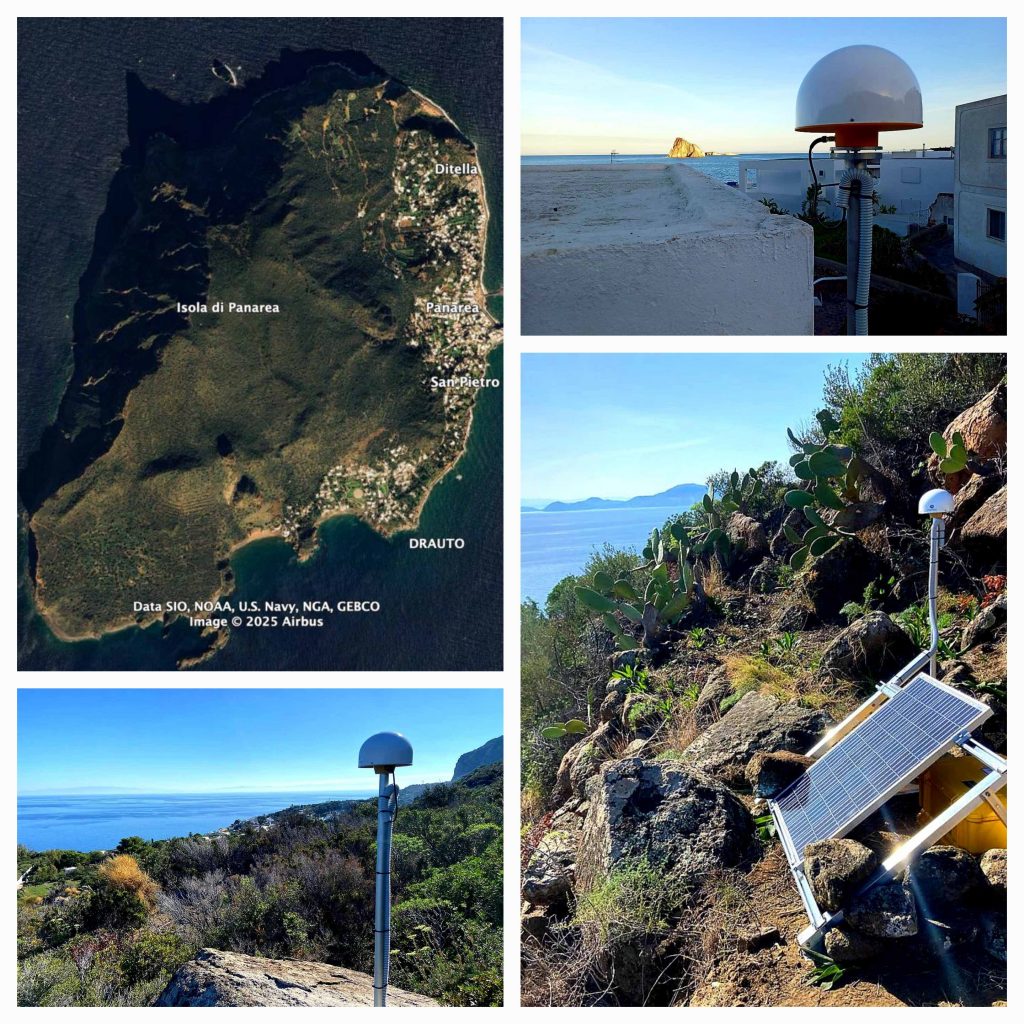
In November, on the island of Panarea, home to one of the Italian natural laboratories dedicated to the study of processes linked to the storage of CO₂ (CCUS – CO₂ Capture, Transport, Utilisation and Storage), we have installed 6 new seismic-geodetic stations within the PNRR ECCSELLENT project, giving life to the first operational nucleus of the new multidisciplinary network that OGS is developing, called AEON – Aeolian Earth Observing Network.
Each station operates independently and is equipped with a GNSS device, a seismometer, a solar panel power supply system with backup batteries and an LTE data transmission unit.
Click below for more information:
👉 https://www.ogs.it/it/rete-sismo-geodetica-di-panarea
👉 https://www.facebook.com/photo?fbid=1717330376051247&set=a.642831080167854